Life As We Know It
Perhaps we should be psychologically prepared for absolutely any eventuality.
Infinite possibilities are no guarantor of outcome. In an infinite chain of natural numbers, it looks as
if the number 2 is the only even prime number, even with an infinite range of possibilities. It seems
there is some unique set of properties of the number 2 (where it comes in the sequence and how it
relates to other numbers) that makes it undeniably unique, even given an infinity of other options.What if there is a unique set of circumstances or an unprecedented sequence of events that led to
life on earth? What if this planet is the very first place in which life has been possible? What if all
attempts at life everywhere else failed and ours was a final attempt which fortuitously succeeded?
What if there was life elsewhere the last of which died out and became extinct billions of years ago
leaving ours as the only surviving outpost in the universe?What if there is organic life dotted here and there but too widely dispersed over vast interstellar and
intergalactic distances for the obstacles to communication or contact to ever become surmountable
(meaning we might never know)? What if there are inorganic life forms in existence whose
physiology and/or sensory systems are so incompatible and divergent from ours that we are unable
to detect each other (meaning we might never know)?What if atmospheric composition, climate, climate cycles, weather patterns, seasonality, polar ice
mass, core rotation, air temperature, surface temperature, tidal patterns, ocean currents, ocean
temperature, oceanic composition, oceanic PH levels, core temperature, core rotation, magnetic
fields, the interplay of planetary, lunar and solar gravitational fields, radiation deflection, solar mass,
solar distance, solar output, solar flare range, planetary mass, orbital distance, orbital plane, axial
tilt, planetary rotation, lunar mass, lunar distance, lunar orbit, tectonic shift, volcanic eruption, ash
cloud plumes, freezes, thaws, floods, land formation, land loss, land reclamation….. all conspired in
unison to create a unique, unparalleled and unrepeatable set of circumstances that make life on
earth unique, even in an endless universe of infinite possibilities?To categorically prove the theoretical constructs that have black holes residing at the centre of
galaxies, we would have to send a probe as close to the nearest one’s event horizon as possible to
conduct meaningful experiments. However doing so falls foul of all the seemingly insuperable
challenges to which deep space exploration seems incapable of finding practical solutions.
Our galaxy’s estimated to be some 100,000 light years across. Nothing we could send to its centre,
with even the fastest conceivable propulsive technology, would get there in under 6-7 million human
generations, travelling from earth’s position near the edge to the centre of our galaxy at the speed
that Voyager 1 is travelling. No information would come back in another 6-7 million generations
(the dissipation of signal over such vast distances would render conventional methods of telemetry
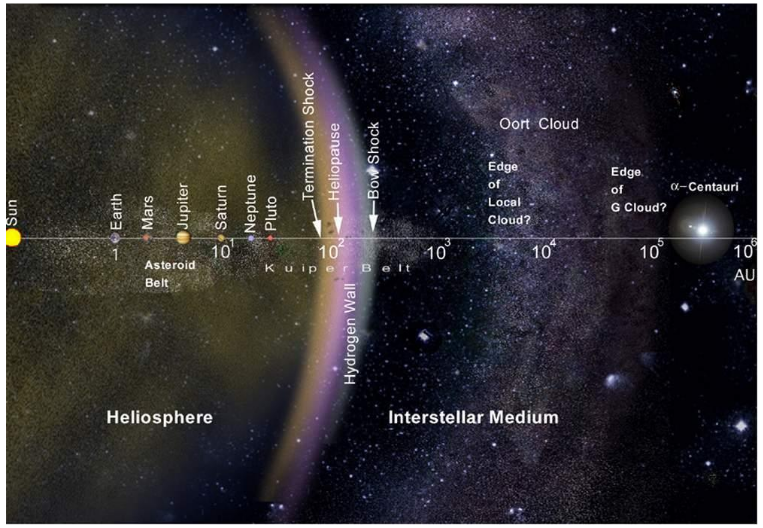
and communication practically impossible).Voyager 1 launched as long ago as 1977 but has only just left our solar system and ventured into the
interstellar space between solar systems within our galaxy. In all that time, Voyager 1 has only
managed to cover 36.5 light hours of distance.
So vast is the universe that light from one of the furthest galaxies detected so far (z8_GND_5296) is
said to have reached the Hubble telescope having started its journey over 13 billion years ago. As the
universe is believed to have been in constant expansion over that time, this remote galaxy is
estimated to now be an even more distant 30 billion light years or so away. So, it would take more
than double the estimated current 13.8 billion year lifetime of the universe for new light that would
show what that galaxy looks like today to reach us.It seems that whatever we do, we will probably never know what objects in the very deepest
observable space look like. All we can ever hope to see is what they might have looked like many
billions of years ago. Note that this is just the “observable” universe. The scale of what we are
unable to detect of it is truly imponderable.Factor in that modern, sapient human beings are deemed to have had only a tiny 200,000 year
wafer thin slice of existence in cosmological terms, in which we have only been able to leave the
ground in the mere sliver of the last 200 years of that time and only been able to leave the planet in
the last gossamer thin nick of only the last 60 years or so.What, therefore, would be the odds of such silk thread thin slits of “technological era” of differing
hypothetical alien civilizations aligning themselves so perfectly as to make contact possible over vast
distances in the tens of billions of years of cosmological timeframes?In the face unknowns, imponderables and likely unknowables, a certain inevitability remains about
the human imperative to wonder, to ask questions, to imagine.Not knowing the answers will never alter this – which is exactly as it should be.
M.S.T.B. (MSc, PhD)